
History of Vision Boards
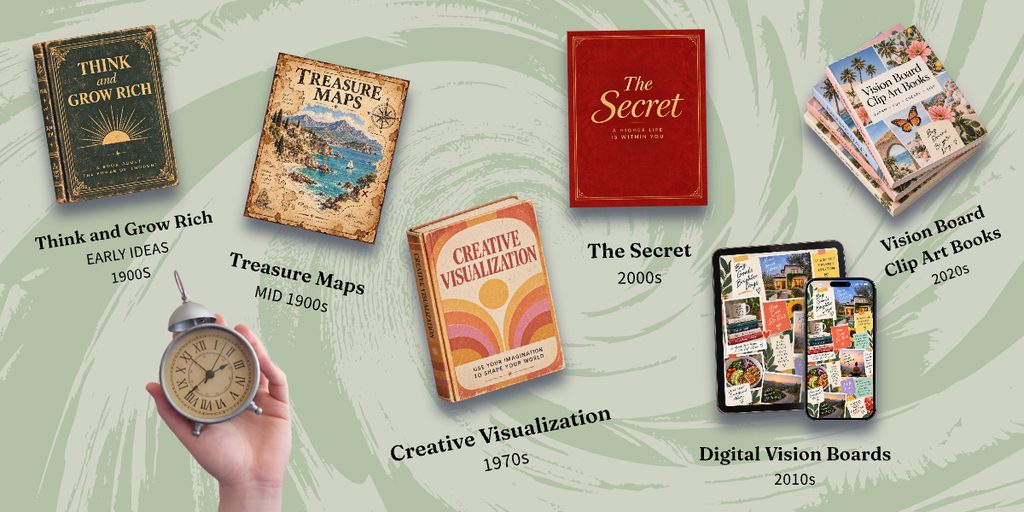
The history of vision boards is more interesting than most people realize. It runs through metaphysical churches, self-help bestsellers, a very famous documentary, and eventually a graphic designer who got tired of digging through old magazines. I even found my place in its development.
For generations, these tools were primarily known as “Treasure Maps” or “Dream Boards.” Their evolution is deeply intertwined with the New Thought Movement of the late 19th and 20th centuries, shifting from sacred spiritual exercises to mainstream corporate and personal development tools.
No single person invented the vision board. But we can trace it, decade by decade, all the way back to a very simple idea: picture what you want before you go get it.
Before the Vision Board
Long before anyone glued a photo of a beach house to a piece of poster board, writers were already teaching people to hold a picture of their future in their minds.
The New Thought movement, which took shape in the late 1800s and early 1900s, built itself around the idea that thoughts and imagination shape experience. In The Science of Getting Rich, published in 1910, Wallace D. Wattles told readers to form a clear mental picture of what they wanted and hold it steady in their minds.
Napoleon Hill picked up the thread in 1937 with Think and Grow Rich. Hill wrote about desire, imagination, and what he called “definite purpose.” He believed imagination was the place where a want first starts to take shape, long before it becomes anything real.
Neither man was making what we’d recognize today as a vision board. But they planted the idea that resides with vision boards today, before you build something in the world, you usually build a picture of it in your head first.
That picture just hadn’t found its way onto paper yet.
Treasure Maps: The First Vision Boards
By the mid-1900s, that mental picture was getting physical.
Inside New Thought churches and prosperity teachings, people started making what they called treasure maps. It’s basically the vision board’s earlier name. A treasure map was a collection of pictures, words, and affirmations representing something the maker wanted, and teachers like Catherine Ponder helped spread the practice through prayer circles and prosperity workshops.
These early boards were more deliberate than we might expect. This wasn’t just gluing whatever looked pretty. Every image had to represent something specific. Want a certain kind of house? A certain kind of relationship? A certain kind of income? You went and found the picture that said exactly that.
The picture became a kind of affirmation you could look at.
That’s the real turning point in the history of vision boards. The desire stopped living only in someone’s head. Now it lived on a piece of poster board, hanging on a wall where they’d see it every day.
Shakti Gawain Names the Practice
The book that really pushed this into the mainstream came out in 1978.
Shakti Gawain wrote the a book calleds Creative Visualization became one of the defining books of the human-potential movement, and it introduced huge numbers of readers to visualization, affirmations, and goal setting. Check out how to use creative visualization for vision boards.
Gawain gave direct instructions for making a treasure map: gather drawings, photographs, and words, and build a physical picture of the life you wanted. That’s recognizably the vision board as we know it today.
Gawain also pulled the practice out of strictly religious prosperity teaching. You didn’t need to be part of a metaphysical church to make one. You could use it for a relationship, a creative project, your health, or just a general sense of the life you wanted to live. The board went from a spiritual tool to a personal development one, and that shift opened the door to everyone who came after her.
Dream Boards, Goal Boards, and the 80s and 90s
By the 1980s and 90s, visualization had gone fully mainstream. Athletes used mental rehearsal before competitions. Business trainers taught goal setting. Motivational speakers told rooms full of people to imagine success before they’d achieved it.
The same collage practice kept showing up, just under different names. Dream boards. Goal boards. Success boards. Treasure maps. Eventually, vision boards.
Some people treated it as spirituality. Some treated it as psychology. Some just liked having a picture on the wall that reminded them what they were working toward. That’s part of why the practice never disappeared. It sat comfortably in between art, goal setting, and belief, and different people could pick it up for completely different reasons.
The Secret and Oprah Sends Vision Boards Mainstream
Then came the moment that changed everything.
Rhonda Byrne’s 2006 film and book The Secret introduced millions of people to the Law of Attraction, and vision boards rode right along with it into mainstream culture.
The story most people remember came from entrepreneur John Assaraf. He described making a board with pictures of the life he wanted, and years later, while unpacking an old box, he found a photo of a house he’d once picked out. He was living in that exact house.
Whatever you make of that story, it stuck. The idea that you could pick pictures of your future, place them somewhere visible, and watch your life bend toward them broke out of New Thought circles and personal-development workshops and became something everyone had at least heard of.
Oprah Winfrey also played an important role in bringing vision boards into mainstream culture. In February 2007, she introduced millions of viewers to The Secret and its ideas about visualization and the Law of Attraction.
Several years later, in September 2014, she welcomed Steve Harvey to Oprah’s Lifeclass, where he shared his own experience with vision boards and the importance of keeping your dreams in front of you. Harvey traced his introduction to the practice back to the 1970s, when it was still known as treasure mapping. Watch Steve Harvey discuss vision boards with Oprah on YouTube.
Vision Boards Get Social
Sometime in the 2000s and 2010s, making a vision board stopped being a private thing you did alone.
Vision board parties started popping up, especially around New Year’s. Friends showed up with magazines, scissors, and glue sticks and spent an evening talking about what they wanted from the year ahead. Workplaces started running their own vision board workshops. People shared their vision boards on social media.
It got popular enough that National Vision Board Day was established in 2015 and now falls on the second Saturday of every January. A practice that started as a quiet, semi-private ritual now has its own day on the calendar. That says a lot about how far it had traveled.
A Book Full of Pictures
I ended up becoming a bit of the history of vision boards almost by accident.
I taught vision board workshops in an art school and watched people dig through stacks of old magazines, hunting for the right picture. And magazines kept getting thinner. People weren’t buying them the way they used to, and it got harder every year to find the range of images people actually needed.
As an artist and former graphic designer, I kept having the same thought. Why isn’t there just a book of pictures made specifically for this?
So in December 2019, I made one. The 2020 Vision Board Clip Art Book gave people a collection of images built purely for cutting and pasting onto their boards. Suddenly you didn’t need a pile of old magazines. You just needed the book.
Hundreds of more clip art books followed, mine and others’, and now there’s a whole category of them. To me, that’s another real chapter in the history of vision boards. The imagery itself became something you could buy on demand and there was a huge market for it.
Vision Boards Go Digital
While all of that was happening, another shift was underway. Vision boards were moving off the poster board entirely.
Pinterest let people collect hundreds of images without cutting out a single piece of paper. Then Canva made it easy for almost anyone to build a polished digital vision board with photos, fonts, and templates, no scissors required.
Your phone became a vision board. People started sizing their boards for laptop backgrounds and lock screens so they’d see their goals every time they checked the time.
Social media pushed things even further. Now every January brings a fresh round of “my 2027 vision board,” “everything on my vision board that came true,” and “making my vision board for the new year.” Making the board isn’t the whole experience anymore. Filming it, posting it, and revisiting it a year later have all become part of the ritual.
Canva is a popular platform to make digital vision boards on. Canva’s own numbers back this up. The company reported that vision board creations on its platform grew more than 13 percent during 2025, alongside a rise in social vision board nights and a shift toward animated and video-based boards.
I taught how to use PowerPoint to create Digital Vision Board Presentations that could be exported as videos and self running slideshows that could be enhanced all year long.
AI and the Next Chapter in the History of Vision Boards
And now vision boards are stepping into something entirely new.
With AI image generation, you’re no longer stuck searching for a photo that sort of, kind of represents what you want. You can just describe it. A quiet painting studio overlooking a garden. A woman in her sixties building a creative life in Mexico. A home that doesn’t exist yet anywhere but your imagination.
That’s a real shift. For the first time, the pictures on the board don’t have to come from something that already exists somewhere in the world. They can come straight from your imagination.
In a strange way, that brings the whole story back to where it started.
More than a hundred years ago, teachers told people to form a clear mental picture of what they wanted. Then people started finding photographs to stand in for that picture. They pasted them onto treasure maps. They called them dream boards, then goal boards, then vision boards. They cut them from magazines, bought books of clip art, pinned them on Pinterest, built them in Canva, put them on their phones, filmed themselves making them, and now they’re asking AI to generate pictures of futures that have never existed anywhere before.
The tools have changed, but I don’t think the reason we make vision boards has changed very much. We want to imagine something beyond the life we already know. We want to explore possibilities, give shape to desires we may not even have words for yet, and discover what matters to us.
That’s what has always fascinated me about vision boards. It’s not simply about collecting pictures of things we want. It’s about what happens when we give ourselves permission to imagine, to create, and perhaps to intentional form our lives and ourselves into a better reality.


